Silent Lessons: Learning Beyond The Classroom Walls and Spotlight
"The Subsurface of Knowledge"- Exploring Nonlinear Learning Journeys and Honoring Quiet Acts of Wisdom

Brilliance Lives in the Details We Often Overlook!
An Opening Inquiry: What forms of intelligence have we been trained to ignore, especially our own? What learning has shaped us the most deeply yet remains unnamed because it does not fit into dominant frameworks of recognition? If liberation is also considered internal then the knowledge we acquire in silence, learning that happens in solitude and education which leaves no paper trails…all matter! Perhaps the most radical question we can ask is not where did you learn this…But what has your learning made possible in you? This is an invitation to sit with that question as you read. It may reveal an education you were never told to value buy you have been carrying all along.
Intelligence is expected to arrive carrying credentials, stamped with legitimacy, endorsed by institutions that decide whose knowing counts and whose does not. In this world, learning is not simply something one does rather must also prove. To be taken seriously, education must be visible, measurable and witnessed. Anything else is treated as incomplete, informal or suspect. Much of the world’s most profound learning happens beyond sight. Forms of knowing that happen outside classrooms, certificates and recognition. Here is an exploration of how people learn in solitude, silence and maybe even in survival. It centers ways of knowing that are not authorized by institutions and are no less rigorous, transformative or real. A deeper look into what becomes possible when we refuse to let recognition be the gatekeeper of unlocking new perspectives and shared knowledge.
1. The Architecture of Recognition and The Erasure it Produces
Modern education systems are architectures of recognition built on histories of exclusion; colonial, patriarchal, racialized and classed. These systems define intelligence narrowly, privileging certain languages, methods and modes of expression while dismissing others as informal or sometimes even unscientific. Knowledge that cannot be standardized is often deemed unreliable. Learning that is not in a position to be assessed is treated as if it never occurred.
This logic can produce a quiet but pervasive violence because it teaches people to distrust what they know unless it has been externally validated. It trains societies to value credentials over consciousness and certification over clarity. In development and education spaces, this translates into policies and interventions that prioritize technical expertise while sidelining lived experience, particularly those who have learned outside formal institutions. When recognition becomes the condition for legitimacy then knowledge becomes conditional. Those without access to systems of recognition are rendered intellectually invisible.
Think of the above discussion like a building that casts shadows. Where light hits, you see clearly. Where it does not then darkness prevails. This analogy explains how recognition structures the “light” and erasure is the inevitable “shadow”. In order to bridge this aspect then we have to expand recognition by including what was excluded, expose and confront erasure by acknowledging the invisible and also redistribute authority which means let communities shape how they are recognized.
2. Learning That Happens in Private often termed as “Education Without Witness”
There is a kind of education that unfolds without applause and often takes place in the private realm such as through observation, reflection, trial and error and inner reckoning. This happens when no one is grading, documenting or affirming that process. The education without witness. An example to further illustrate this would be…when a woman teaches herself to navigate power by watching who is interrupted and who is heard. The learning that emerges when someone studies patterns of harm to avoid them or studies systems of care to reproduce them. The underlying differentiator about this form of learning is that it could happen late at night, in moments of doubt or in silent decisions to do things differently than before.
A form of learning not motivated by credentials or career advancement but by survival, dignity and the desire for coherence between one’s values and actions. In that way, it becomes unseen and often dismissed. The invisibility is precisely what allows it to be honest because there is no performance here only integration. Education that does not necessarily ask to be believed but to be lived.
We can actually bridge private, intrinsic learning with social recognition without getting too tied to specifics like credentials through a number of ways such as; document and reflect, translate learning into observable forms, engage with communities, connect private learning to purpose, create mechanisms for recognition and value the intrinsic motivation.
3. An understanding of the Gendered Pathways of Unseen Learning
Un-credentialed intelligence is deeply gendered, shaped by roles and constraints imposed on lives. For women, especially those navigating patriarchal systems learning has often been a matter of necessity rather than choice. Women learn to read rooms, to anticipate conflict, manage emotional and material scarcity. They learn systems of power not from textbooks but from proximity…being subjected to them. This form of learning is rarely named as intellectual labor. Framed instead as resilience or instinct…terms that depoliticize and devalue the depth of analysis involved. It is complex, strategic, deeply contextual and reflects an education in relational dynamics, ethics and survival that no certificate can fully capture.
For many men, particularly in societies that discourage emotional literacy and vulnerability, learning happens in isolation. It emerges through failure, harm recognized too late or through private confrontation with one’s own conditioning. This learning is often silent because it lacks social permission. There is no recognized curriculum for unlearning entitlement or interrogating internalized power. This kind of education becomes transformative but will ultimately remain unseen.
How can we center un-credentialed intelligence? Honoring these gendered pathways of knowing without forcing them into a single narrative or hierarchy. What appears unrecognized often carries expertise forged through experience, resilience and sustained attention.
4. Embracing the Concept of Knowledge Without Permission
This means the refusal to wait for institutional approval to think critically, reflect deeply or to change one’s worldview. This act has always been present in liberal movements. Enslaved people learned to read in secret, indigenous communities preserved knowledge systems in defiance of colonial erasure while women educated each other in kitchens, collectives and whispered conversations.
While many view this approach to knowledge as reckless, it is actually very deliberate. It arises when formal education is inaccessible, hostile or insufficient. Shaped by urgency and not prestige. The fact that it is not conferred by authority, what is required is a profound trust in one’s own capacity to learn. This trust in itself is a form of autonomy. In a world that teaches people to always outsource their thinking to experts and institutions, reclaiming intellectual self-trust is a radical act and is the key foundation of liberation. Mindset shifts, ethical awakenings and internal transformations are the changes that sustain long-term development but are rarely recognized as legitimate outcomes. Truth is, without them the structural interventions often falter.
Learning is not limited by gatekeepers (universities, employers, authorities) which means anyone can access, create and share knowledge. This empowers communities and encourages the curiosity-driven exploration rather than compliance with formal rules. A key strategy to foster and enhance the need to democratize knowledge. Intellectual autonomy also means self-directed inquiry, experimentation and critical thinking. Learners are able to take ownership of their individual learning journey and it reduces the dependence on institutional validation to know that knowledge matters. Knowledge without permission also gives room for risk-taking, unconventional ideas and encourages innovation. You will find that a number of breakthroughs come from people who were not “officially authorized” to pursue a particular field.
Ps: Not all knowing can be audited and not all learning can be displayed. Some of the most important education happens internally and it often reshapes how people understand themselves, others and the world.
5. Bridging the Gap: Learning as Integration versus Accumulation
Transformative Education is not accumulating information but a focus on integration which means allowing education to alter how one lives, relates and acts. This is where education that is not based on credentials excels because it is not abstract. What are the dynamics? It is embodied, contextual, resonates and immediately relevant. This is where self-reflection becomes central because people synthesize experience into wisdom. Learning becomes ethical rather than merely technical. When education prioritizes integration over accumulation then there is a shift from just producing experts to cultivating conscious humans. Something quite essential for gender-inclusive development because change must be both structural and internal.
We should promote connections across domains and this includes encouraging cross-disciplinary thinking as well as drawing links between seemingly unrelated subjects to see patterns and principles. The importance of also valuing process over product by shifting emphasis to understanding, insight and adaptability. In this case, the recognition will further include synthesis, creative problem-solving or teaching others. More focus towards embracing the application of knowledge in interdisciplinary projects. The essence here is making learning reflective, applied, connected and valued for understanding and not just for the credentials.
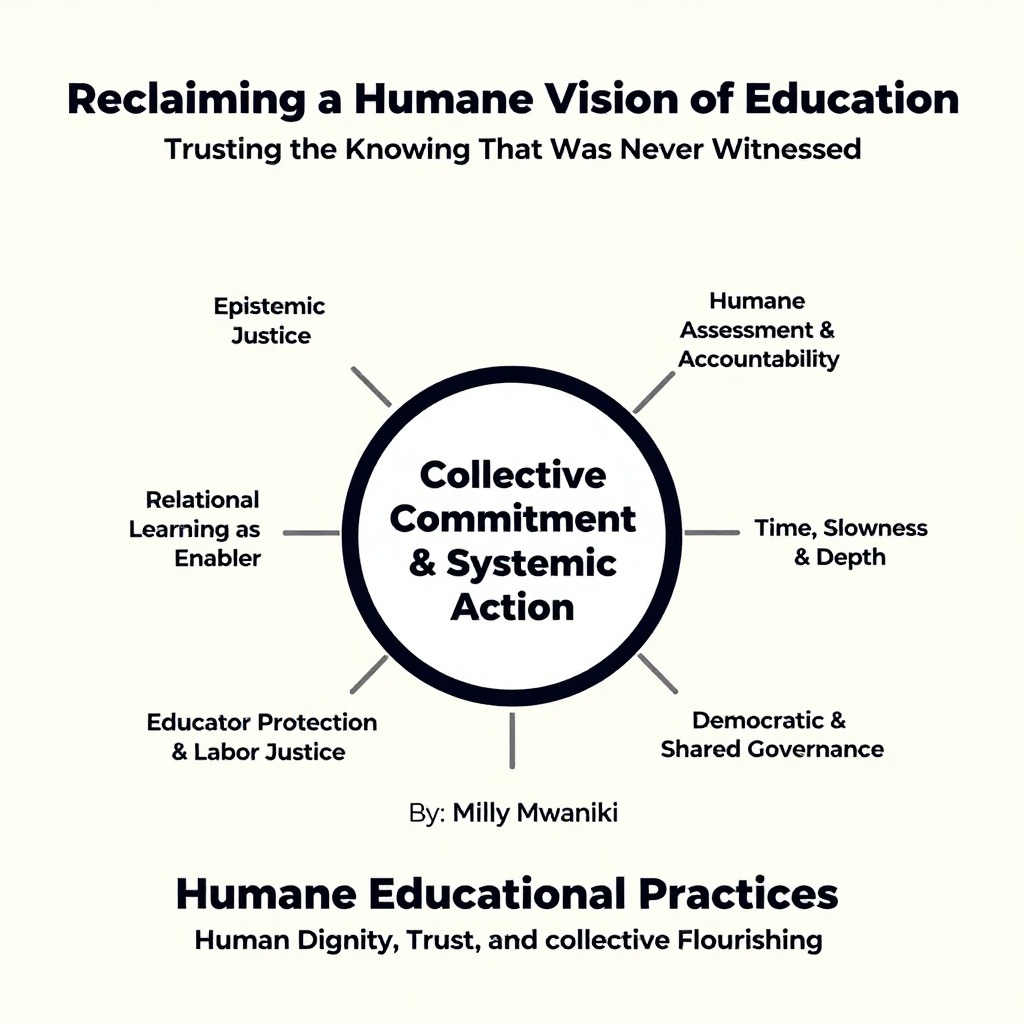
How can we move towards Reclaiming a More Humane Vision of Education?
Centering “education without witness” is not to reject institutions outright but challenging the monopoly on legitimacy. More about insisting that learning is a human capacity before it is a professional one. Widen our understanding of intelligence to include the unseen, informal and the unrecognized. A humane vision for education actually asks different questions. Not necessarily where someone studied but how they think. Not what they can prove but how they have been transformed. Not whether their knowledge fits existing frameworks but whether it expands our collective capacity for justice, equity, inclusion, care and dignity.
This approach requires integrating pedagogies that are contextually relevant and culturally sensitive. Education should respect and incorporate languages and knowledge systems, recognizing that human development is diverse and multifaceted. Such dynamics help to challenge the one-size-fits-all model and promote a pluralistic understanding of intelligence and success. Education becomes a process of discovery and dialogue fostering a sense of global citizenship in mutual understanding. A movement that is necessary to the complexities of evolution as it demands a profound shift in priorities from economic efficiency to human flourishing, standardized testing to personalized growth and from hierarchy to community. The importance of illuminating these core values and advocating for systemic change is ensuring we can create educational spaces that nurture the full spectrum of human potential, cultivating compassionate, thoughtful and resilient individuals prepared to build a more just world.
In honoring education and liberation, let’s also affirm a simple but radical truth; people are capable of learning, reflecting and transforming themselves even when the world refuses to acknowledge it. Knowledge does not need to be seen to be real, intelligence even when not certified is very powerful and learning will not necessarily require an audience to be meaningful. This kind of understanding allows people to focus on building a world where education serves humanity and not hierarchy.
Here are key practices or strategies that require collective commitment and systemic action;
Recognize lived experience, embodied knowledge, wisdom, intuition and communal learning as legitimate epistemic sources.
Replace extractive assessment models with narrative evaluation, portfolios, collective assessment and reflective practices.
Protect slowness, depth and under-coverage in curricula. Additionally, create long-term arcs and continuity of relationships.
Design small learning communities, sustained mentorship and continuity between educators and learners.
Ensure academic freedom in practice, humane workloads and protection for critical and caring pedagogies.
Include diverse educators, learners, families and community in decision-making with real authority.
Redefine rigor as depth and ethical engagement. Value reflection, uncertainty and transformation over performance.
Integrate restorative justice, mental health support and collective care into educational structures.
Support community-based, cooperative, indigenous and intergenerational learning ecosystems.
“Learning is not a collection of facts but the weaving of understanding across contexts, experiences and ideas. Capacity to reflect and transform. Accumulating knowledge is easy but integrating different themes into insight is the true measure of growth. The future of education lies in embracing the full spectrum of human knowing- visible and invisible alike”
Ps: If you found this piece interesting or insightful, please share it with a friend and stay connected- Subscribe & Follow. Feel free to stick around, explore and see what unfolds. Follow along and be part of conversations where we share perspectives, rise and rewrite the rules.
This is a soft landing; reclaim, unlearn, grow and reimagine the world we live in. To have discussions on diverse topics, challenge assumptions, resist imposed identities and reflect on the kind of change that begins from within. Let’s rethink, reconnect and realign together. Whether you are a leader, educator, quiet disruptor, someone seeking to learn or simply just get the vibe…this space is for you!
Thank you for reading. Catch you in the next post!
Milly
Hello, so happy to connect with you 🤍 I just subscribed to your content, and I hope you feel like subscribing to mine too 💌 xx